Historic Property #8: Jay W. & Jessie Fox House
Address: 825 Spring Street (Historically, 49 Spring Street)
Year Built: Circa 1936
Architect: Unknown
Builder: Unknown
Architectural Style: Spanish Colonial Revival
Built in 1936, the remarkably intact home at 825 Spring Street exemplifies how the Spanish Colonial Revival style of the 1930s was adapted to the Great Depression. The asymmetrical exterior features a low pitched red clay Mission tile roof, smooth white stucco cladding, distinctive diamond shaped windows, and a prominent battered chimney with inset tiles. Visitors enter through the original wood front door, which retains its period hardware, into an interior showcasing wide plaster archways, original oak flooring, a sculpted asymmetrical stucco fireplace, and a charming arched telephone niche. The property offers a rare look at 1930s domestic life, retaining original bathroom tilework alongside a classic kitchen equipped with flat panel cabinetry, a cast iron sink, and a vented cooler cabinet.
This notable home was built for prominent Placerville residents Jay Woodward "Woody" Fox and his wife Jessie Marie Orr Fox. Born in Placerville in 1909, Woody came from a deeply rooted pioneer family. His grandfather John Fox arrived in 1852 as a blacksmith. Woody's father and uncle later operated Fox Brothers Pharmacy at 360 Main Street, a building that also housed the central office of the Capital Telephone Company. There, his father operated the first telephone switchboard in Placerville in 1894. After graduating from the College of Pharmacy in 1931, Woody joined the family business.
In June 1934, Woody married Jessie, who had moved to Placerville in 1919 and studied art at San Jose State College. Their new home was constructed on the rear lot of Woody's childhood residence, replacing the carriage house behind his father’s Victorian home at 2934 Coloma Street. Jessie brought a vibrant creative spirit to the household, expressing her talents through sewing, ceramics, and watercolor.
During World War II, Woody served in Italy as a United States Army sergeant while Jessie managed the family pharmacy back home. Both became pillars of civic life. Woody was active in the Masonic Lodge, the Elks, the Native Sons of the Golden West, and E Clampus Vitus. As the health and welfare chairman for the Lions Club, he directed assistance programs for those in need. Jessie, affectionately known as Aunt Jess, was equally engaged and deeply beloved by the community.
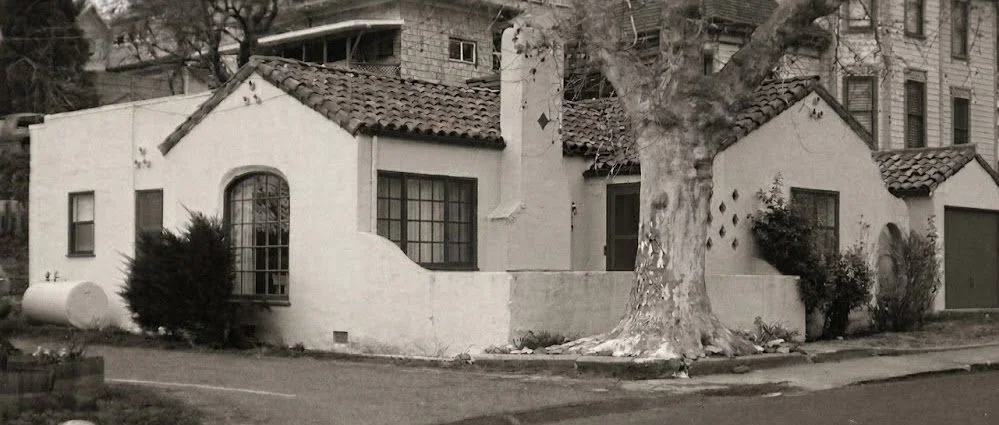
Photo reconstruction
Woody died suddenly of a heart attack in 1955 at the age of 46. Jessie lived until 1991, though their Spring Street home changed ownership by 1963. Today, the Jay W. Fox House stands as a rare and enduring example of Spanish Colonial Revival architecture in the Sierra Foothills.